Papakōlea Green Sand Beach: Cost, Hike Difficulty & Is It Worth It
There are only a handful of green sand beaches anywhere on the planet, and one of them sits at the exact southernmost point of the United States, at the end of a walk nobody undersells by accident once they've done it.
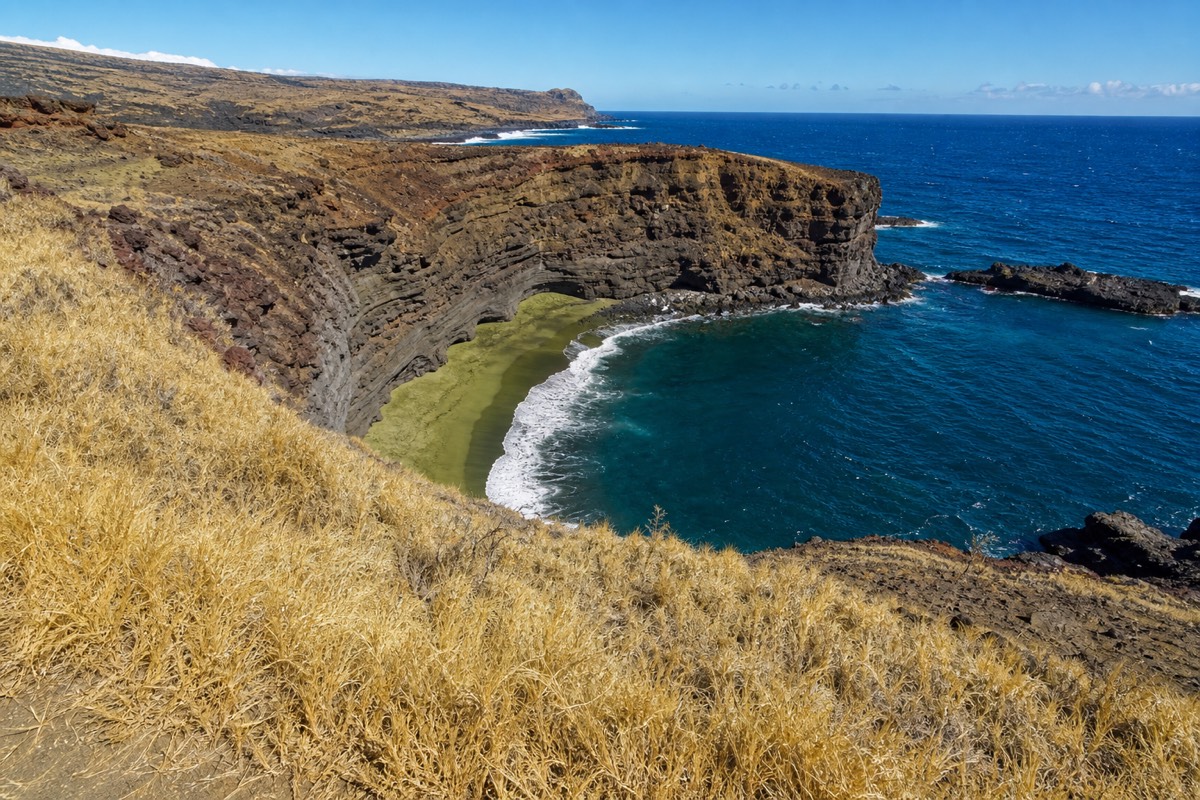
Is Papakōlea Green Sand Beach worth it?
Yes, for travelers willing to commit to a long, exposed walk. Green sand is a genuine rarity worldwide, and Papakōlea's setting, a cove half-enclosed by an eroding cinder cone at the very tip of the island, is dramatic enough to justify the effort on its own.
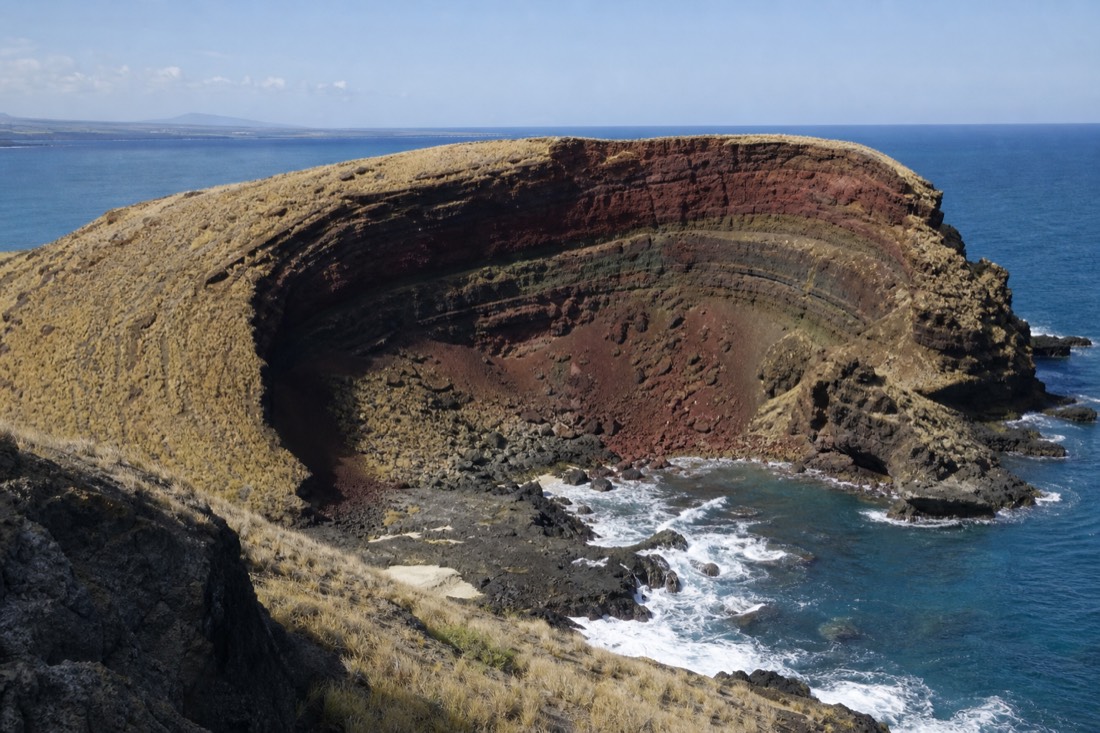
What makes it worth planning for rather than adding on impulse is exactly what makes it rare: there is no easy version of this trip. Plan the walk or choose a different beach. Nobody arrives at Papakōlea by accident, and that filters out the crowds that overwhelm easier stops elsewhere on the island.
How much does it cost to visit Papakōlea?
Walking is free. There is no entrance fee, gate or ticket for the beach or the trail. The cost most visitors actually pay is either the physical toll of a 5-to-6-mile round trip in full sun, or a cash fare to one of the unofficial local drivers waiting at the trailhead.
Informal paid rides may be offered at the trailhead. A cash fare or an online tour listing is not proof of authorized beach access. Plan to walk and follow current land-access rules.
| Option | Cost | What you're getting |
|---|---|---|
| Walk the trail yourself | Free | 2.5–3 miles each way, fully exposed, roughly an hour each direction |
How hard is the hike to Papakōlea?
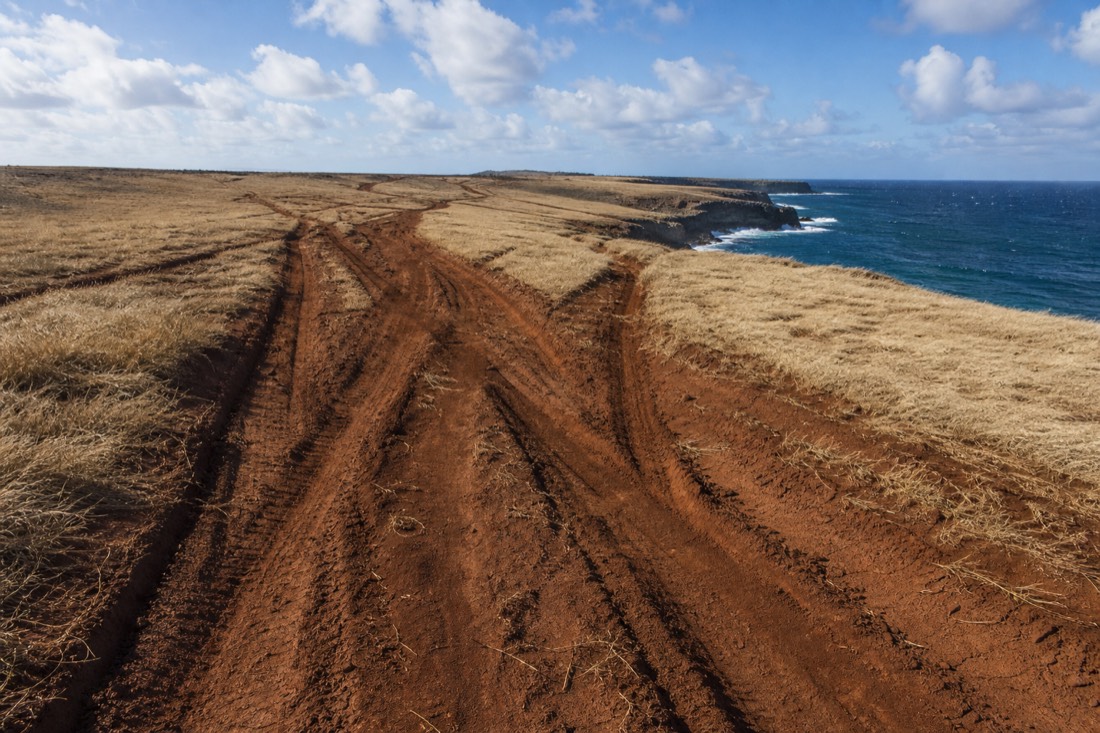
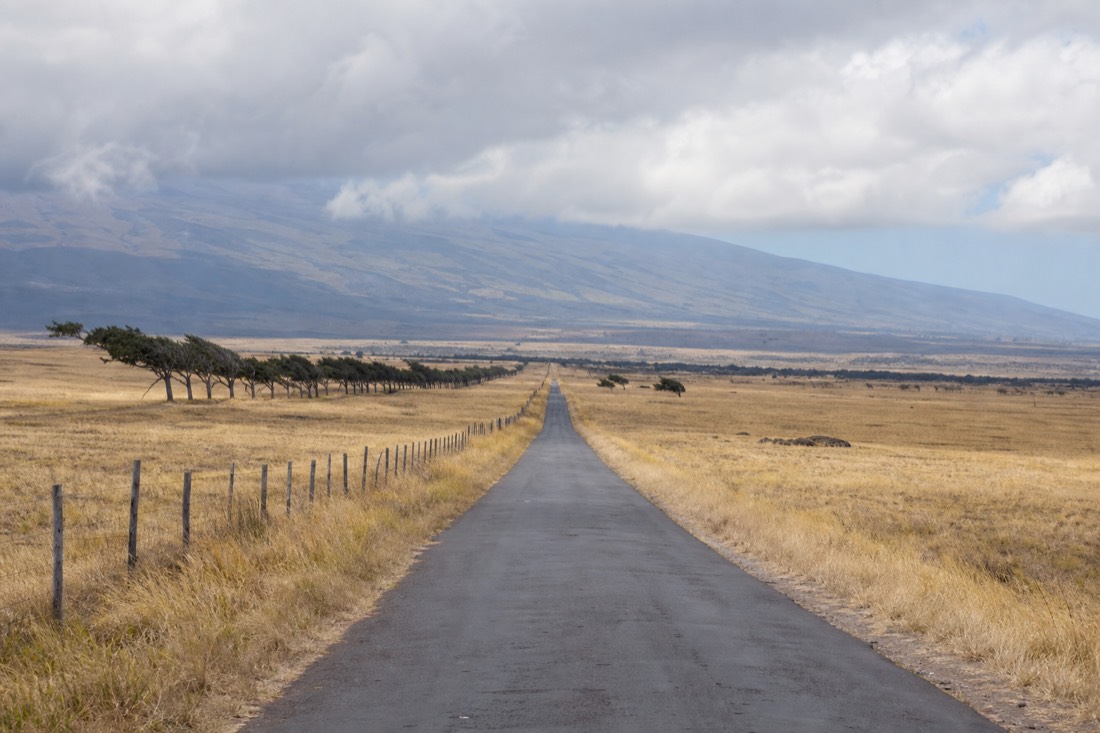
It is roughly 2.5 to 3 miles each way on an unpaved, unshaded track, which puts the round trip at 5 to 6 miles. The distance itself is moderate; what makes it genuinely hard is the total absence of shade and the steady South Point wind, not the terrain underfoot.
Budget about an hour each way at a normal walking pace, more if you're stopping often or the wind is fighting you. There is no water source anywhere on the route and no facilities at either end. People who underestimate this hike almost always underestimate the exposure, not the distance; a 5-mile walk sounds manageable until you've done all of it under direct sun with a stiff onshore wind and nowhere to duck out of it.
| If this describes you | Honest verdict |
|---|---|
| Regular walker, brings enough water | Manageable. Start early and bring more water than feels necessary. |
| Heat-sensitive or prone to sunburn | Plan a different, easier-access beach if the exposed walk does not suit your group or available time. |
| Traveling with young kids | Plan a different, easier-access beach if the exposed walk does not suit your group or available time. |
| Short on time | Plan a different, easier-access beach if the exposed walk does not suit your group or available time. |
What should you bring, and when's the best time to go?
More water than feels necessary, a hat, real sun protection, and closed shoes that can handle loose cinder. Go early in the morning, both for cooler temperatures and to give yourself the full round trip before the afternoon wind picks up.
There's genuinely nothing to buy once you're past the parking area, no shade structure, no vendor cart, no water fountain. Whatever you're carrying when you leave the car is what you have for the next two to three hours. Wind at South Point is a near-constant feature of the geography, not an occasional inconvenience, so plan for it rather than hoping it stays calm.
| Item | Why it matters here |
|---|---|
| Water, more than one bottle per person | No water source anywhere on the route |
| Hat and reef-safe sunscreen | Zero shade for the full 5–6 mile round trip |
| Closed shoes with grip | Loose cinder track, uneven in places |
| Windbreaker or light layer | South Point's wind is constant and can be surprisingly cool |
| Cash | The only payment the informal drivers at the trailhead take |
Can you swim at the green sand beach?
Technically yes, but conditions are usually rough, the cove has no lifeguard, and there is no facility of any kind nearby if something goes wrong. Most visitors wade rather than swim, and plenty just look.
The same wind that makes the hike hard also stirs up the water inside the cove, and currents around the exposed southern tip of the island are not to be underestimated. Go in only if conditions look genuinely calm on the day, and never alone.
Why is the sand green?
The cove sits inside Puʻu Mahana, an old, eroding cinder cone built largely from olivine-rich basalt. Olivine, a dense green mineral, survives being ground down by waves far better than the lighter black volcanic ash around it, so as the cone erodes, the olivine concentrates on the beach while the lighter material washes out to sea.
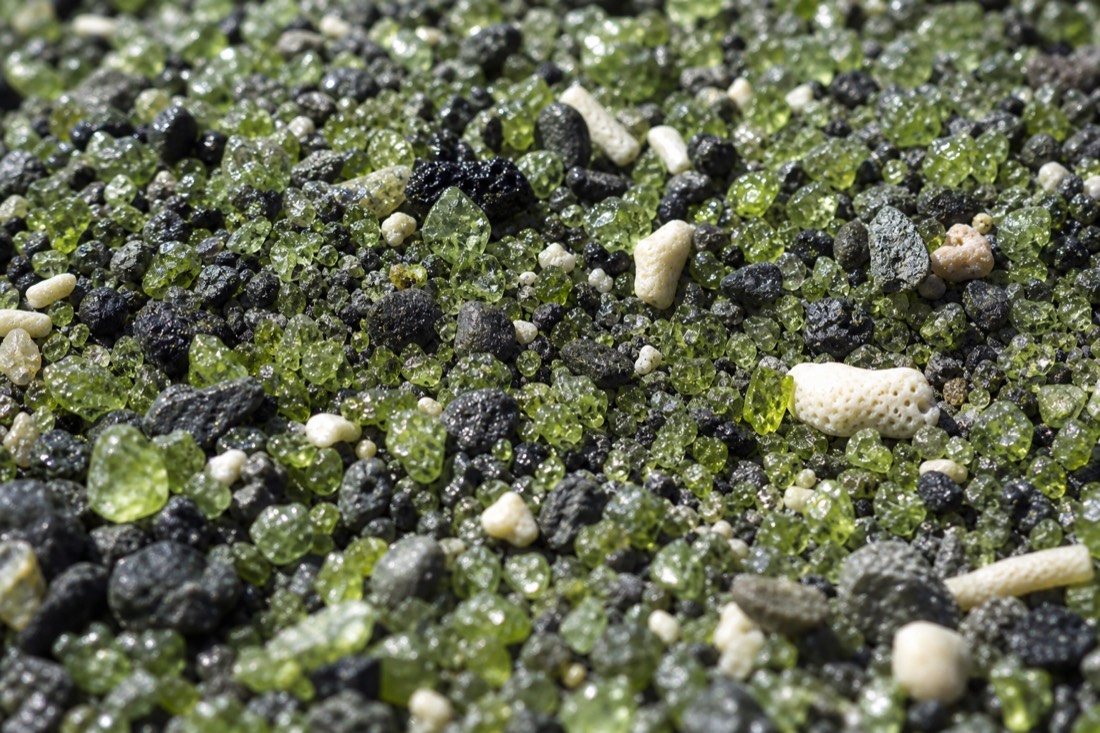
It's the same basic idea as black sand forming elsewhere on the island, lava rock breaking down under wave action, just with a different mineral left behind at the end. Very few places on the planet have a cinder cone rich enough in olivine, positioned right where the ocean can grind it down and concentrate it on a beach, which is exactly why green sand beaches are so rare worldwide. Ka Lae, the point beyond the beach, is recognized as a National Historic Landmark in its own right; the National Park Service's entry on the South Point Complex covers the area's deeper human history alongside its geology.
Is South Point worth visiting even without the beach hike?
Yes. Ka Lae itself, the actual southernmost point in the United States, sits right at the trailhead and needs no hike at all. It carries real historical weight as a documented Native Hawaiian settlement and fishing site alongside the geographic novelty.
The area is believed to be one of the first places Polynesian voyagers reached when they arrived in Hawaiʻi, and the remains of heiau (temple sites) and fishing shrines are still present around the point. Even travelers who decide the green sand hike isn't for them on a given day get a genuine landmark out of the drive alone, the literal southern edge of the country, with sheer sea cliffs and a small boat hoist locals still use to lower canoes to the water below.
| At Ka Lae / South Point | What it is |
|---|---|
| Southernmost point marker | The literal southern tip of the United States, no hike required |
| South Point Complex | National Historic Landmark, designated 1962 |
| Heiau and fishing shrine remains | Evidence of early Polynesian settlement |
| Boat hoist | Still used by local fishermen to lower boats down the sea cliffs |
| Papakōlea Green Sand Beach | 2.5–3 miles further along the coast on foot |
Can you drive to Papakōlea yourself?
You can drive the paved South Point Road to the parking area, but the final unpaved stretch to the beach itself is off-limits to standard rental cars. Every major rental agreement on the island prohibits driving that section, and doing it anyway risks both a stuck vehicle and a voided contract.
This is the single most repeated warning about this beach for a reason: people try it anyway every season, and it consistently ends badly, a rental sedan buried in soft cinder a mile from help. Park at the designated area and walk from there. The final stretch also crosses land where motorized access is formally restricted, which is part of why an informal cash economy of local drivers exists at the trailhead in the first place.
What's the real, bookable way to do this?
The Green Sands Adventure ATV listing describes a trail through woodland to ocean cliffs. It does not establish an authorized visit to Papakōlea Beach. The exact older beach-tour listings checked for this guide are inactive.
Nāʻalehu is a separate south-island destination, roughly two hours from Hilo. Allow the full day for the drive and the exposed walk; do not use an ATV listing’s two-hour duration as the total time for reaching this beach.
If you'd rather stay closer to Hilo and see a different kind of coastline, our black sand beaches guide compares the island's other volcanic beaches, all considerably closer to town.
How does this compare to the island's black sand beaches?
Green sand is rarer than black sand, but the black sand beaches are considerably easier to reach. Punaluʻu and Kaimū both have direct road or short-walk access with no hike required, where Papakōlea demands miles on foot.
Neither is a substitute for the other, they're genuinely different sights. If your trip has room for only one south-side beach and effort is a real constraint, Punaluʻu delivers more for less. If the rarity of the color itself is the draw, nothing else on the island gives you that.
How has visiting Papakōlea changed over the years?
The core experience, a long walk to a remote cove, hasn't changed in decades. What has changed is the informal transport economy at the trailhead, which has grown alongside the beach's social media visibility, and increased attention to the rental car restriction after repeated, costly recovery incidents.
Older travel writing about this beach sometimes undersells the walk or glosses over the informal driver situation as a minor curiosity. Neither holds up well against current reality: the hike is genuinely demanding in full exposure, and the driver economy at the trailhead is a fixture serious enough to plan around rather than stumble into. Treat any pre-2020 description of "just drive down and walk five minutes" as unreliable.
The one durable constant is the geology itself. Puʻu Mahana isn't eroding meaningfully faster or slower than it was a generation ago on any timescale a visitor would notice, so the sand, the cove and the view are, geologically speaking, the most stable part of the whole experience.
Is there anywhere else in Hawaiʻi, or the world, with green sand?
Green sand beaches are consistently described as among the rarest beach types on Earth, with only a small handful known worldwide. Papakōlea is the one most accessible to travelers, which is a large part of why it draws visitors from well beyond Hawaiʻi specifically to see it.
The rarity comes down to a narrow set of conditions all having to line up at once: a volcanic source rock unusually rich in olivine, a cinder cone positioned exactly where erosion and wave action can concentrate that mineral rather than scatter it, and enough time for that process to actually produce a visible beach rather than a scattering of green grains lost among ordinary sand. Most volcanic coastlines simply don't check every one of those boxes together, which is why green sand beaches stay a genuine geological rarity rather than an occasional variation you'd expect to see more often.
That rarity is exactly why it's worth being honest about the effort this beach demands rather than glossing over it to sell the destination. A place this uncommon doesn't need exaggeration to justify the trip, and a visitor who arrives with accurate expectations about the hike, the wind and the sand's origin gets more out of standing there than one who was sold an easier version of the day.
Compare that to a beach you can simply drive up to, and the calculus changes. Papakōlea rewards travelers who plan for the walk properly rather than those hoping to squeeze it in as a five-minute detour on the way to somewhere else. Build a real block of time around it, on foot , and it delivers. Rush it, and the wind, the distance and the lack of shade will make sure you notice.
Most people who regret the visit didn't budget enough time, not enough will. Treat this as a half-day commitment once the drive down from Hilo is included, rather than one stop among five on a single South Point afternoon, and the odds of leaving satisfied go up considerably.
What's the wind and weather like at South Point?
Consistently windy, more so than almost anywhere else on the island. South Point sits fully exposed to the trade winds with no higher ground or vegetation to break them, and that wind is a defining feature of the hike, not an occasional condition.
Afternoons tend to be windier than mornings, another reason to start the walk early rather than late. Temperatures themselves stay mild year-round, this is one of the drier, sunnier corners of the island rather than a wet one, but the steady onshore wind can make it feel noticeably cooler than the thermometer suggests, especially with sun-damp skin on the walk back.
| Papakōlea (green) | Punaluʻu (black) | |
|---|---|---|
| Access | 2.5–3 mile hike each way | Short walk from parking |
| Cost to reach | Free on foot | Free |
| Rarity | One of very few green sand beaches on Earth | Common on this island, still rare globally |
| Facilities | None | Parking, restrooms nearby |